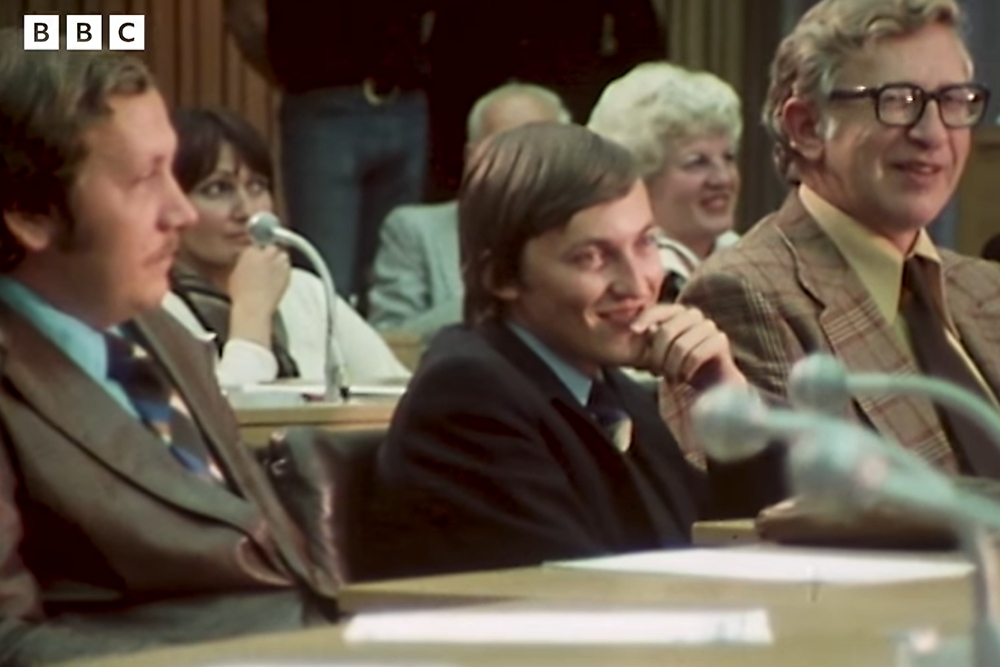
26/08/2026 – La BBC ha publicado en YouTube un documental de 1977 procedente de sus archivos sobre Anatoly Karpov, quien por entonces era el campeón mundial de ajedrez. El programa repasa el ascenso de Karpov hasta conquistar el título mundial e incluye imágenes del Torneo Interpolis de 1977 en Hilversum, con la participación de muchas de las figuras más destacadas del mundo del ajedrez.
novedad: Fritz 20
Your personal chess trainer. Your toughest opponent. Your strongest ally. FRITZ 20 is more than just a chess engine – it is a training revolution for ambitious players and professionals. Whether you are taking your first steps into the world of serious chess training, or already playing at tournament level, FRITZ 20 will help you train more efficiently, intelligently and individually than ever before.
YOUR PERSONAL CHESS COACH - Whether you’re taking your first steps into the world of club chess, or already playing at a tournament level: with FRITZ, you can train more efficiently, intelligently and with a more personalised approach than ever before. FRITZ is more than just a chess engine – it’s a training revolution! Whether you’re taking your first steps into the world of club chess, or already playing at a tournament level: with FRITZ, you can train more efficiently, intelligently and with a more personalised approach than ever before.
Chess is a concrete game. There is no way around training your calculation skills. Improve your visualization, pattern recognition and learn calculation techniques such as reciprocal thinking with this course.
39,90 €
La fiebre del ajedrez en la década de 1970
En la década de 1970, el ajedrez de competición comenzó a atraer una gran atención. Al principio, esto se debió en buena medida a Bobby Fischer: sus éxitos, sus excentricidades y, finalmente, su victoria sobre Boris Spassky en el match por el Campeonato Mundial de 1972 en Reikiavik. El encuentro recibió una amplia cobertura en todo el mundo. Quienes esperaban que Fischer ofreciera a partir de entonces una serie de apariciones deslumbrantes en torneos pronto se sintieron decepcionados. Fischer recogió los laureles, subió a un avión y desapareció. Aunque no del todo. El nuevo campeón mundial siguió rondando como un fantasma por las revistas y los periódicos de ajedrez. De vez en cuando aparecían noticias según las cuales estaba a punto de regresar o que había sido visto aquí o allá. En realidad, Fischer no disputó ni una sola partida de torneo como campeón mundial, y tuvieron que pasar otros 20 años antes de que finalmente volviera a sentarse ante un tablero.
Entre Capablanca y Carlsen en cuanto al estilo, entre Fischer y Kasparov en lo que respecta a la cronología, Anatoly Karpov tiene mucho que enseñar sobre su sentido de la coordinación y la armonía.
En 1975, Fischer debía defender su título contra el nuevo aspirante, Anatoly Karpov. Sin embargo, Fischer planteó exigencias que no pudieron aceptarse y, por tanto, no jugó. Karpov se convirtió así en campeón mundial sin disputar el encuentro, y el nuevo entusiasmo internacional por el ajedrez pronto se trasladó hacia el soviético.
En muchos aspectos, Karpov era todo lo contrario de Fischer. Mientras que el alto estadounidense era ruidoso y desafiante —«excéntrico», como se lo describía a menudo—, el menudo Karpov era reservado y discreto. Pero, a diferencia del desaparecido Fischer, Karpov tenía una presencia constante en el circuito de torneos. Como nuevo campeón mundial recibió numerosas invitaciones y aceptó la mayoría. Y cuando jugaba, lo hacía de una manera digna de un campeón del mundo, aunque con un estilo muy distinto al de Fischer.
La fiebre del ajedrez se había extendido con especial fuerza en Inglaterra. En 1972, el millonario inglés Jim Slater ayudó a garantizar que el match por el Campeonato Mundial entre Spassky y Fischer llegara a disputarse al aumentar el fondo de premios. El encuentro había estado seriamente en duda porque el imprevisible Fischer no había llegado a tiempo y había planteado exigencias económicas adicionales, que Slater satisfizo.
Slater también fue responsable de cierto auge del ajedrez en Inglaterra cuando ofreció £5.000 al primer jugador inglés que consiguiera convertirse en gran maestro. En la década de 1970, £5.000 valían considerablemente más que hoy, y el título de gran maestro seguía siendo una distinción relativamente poco común. En 1976, Tony Miles se convirtió finalmente en el primer gran maestro de Inglaterra.
La BBC reaccionó al creciente interés por el ajedrez. En 1976 lanzó su legendaria serie televisiva The Master Game, un innovador formato de torneo concebido específicamente para una audiencia televisiva. Estos torneos televisados, con jugadores de primer nivel mundial, continuaron hasta 1983. La cadena alemana NDR adaptó varios de ellos y los emitió durante la época navideña.
La BBC también produjo varios documentales sobre torneos de ajedrez. Uno de estos programas de su archivo ha sido subido ahora a YouTube. Titulado Where Karpov Is King, analiza el dominio del nuevo campeón mundial. Parte de las imágenes se filmaron durante el Torneo Interpolis de 1977 en Tilburg. Entre las grandes figuras del ajedrez de la época que aparecen en pantalla se encuentran el presidente de la FIDE, Max Euwe, Vasily Smyslov, Jan Timman, Tony Miles y Robert Hübner.
YOUR PERSONAL CHESS COACH - Whether you’re taking your first steps into the world of club chess, or already playing at a tournament level: with FRITZ, you can train more efficiently, intelligently and with a more personalised approach than ever before. FRITZ is more than just a chess engine – it’s a training revolution! Whether you’re taking your first steps into the world of club chess, or already playing at a tournament level: with FRITZ, you can train more efficiently, intelligently and with a more personalised approach than ever before.
YOUR PERSONAL CHESS COACH - Whether you’re taking your first steps into the world of club chess, or already playing at a tournament level: with FRITZ, you can train more efficiently, intelligently and with a more personalised approach than ever before.
Keep it simple. Stay objective. Watch the clock. Sometimes take the risk. GM Loek van Wely explains the ten principles that decide real games. They aren’t about theory. They’re about what you do at the board when it counts.
“Attack with Qh5!!” – Tactical training with Oliver Reeh, “6…g5 – nothing ventured, nothing …” – Le Quang Liem comments on one of his victories in Biel, “Grischuk’s stroke of genius” – Petra Papp reveals a surprise in the Sicilian Kan Variation, and much
Most players don’t lack the urge to attack, they just strike at the wrong moment, and GM Sipke Ernst shows you which signals tell you to go for the king and which tell you to choose another plan.
How grandmasters win without fireworks: GM Jan Markos shows you 11 very practical tips from "How to play in a lost position" to "Be patient like Carlsen" that will improve your tournament chess.
The Nimzo-Indian has stood the test of time for over a century: Still a top choice for elite players today, from Magnus Carlsen to Praggnanandhaa, it remains one of Black's most reliable ways to fight for real chances against 1.d4 2.c4 3.Nc3.
1.c4 e5 2.Nc3 Bb4!? is an opening idea well worth considering. Black immediately threatens to double the pawns on c3 in the style of the Trompowski or Sicilian Grand Prix attack.
In this 60-minute video course you’ll learn how to use the Austrian Defence as a practical weapon for Black!
9,90 €
We use cookies and comparable technologies to provide certain functions, to improve the user experience and to offer interest-oriented content. Depending on their intended use, analysis cookies and marketing cookies may be used in addition to technically required cookies. Here you can make detailed settings or revoke your consent (if necessary partially) with effect for the future. Further information can be found in our data protection declaration.
Pop-up for detailed settings
We use cookies and comparable technologies to provide certain functions, to improve the user experience and to offer interest-oriented content. Depending on their intended use, cookies may be used in addition to technically required cookies, analysis cookies and marketing cookies. You can decide which cookies to use by selecting the appropriate options below. Please note that your selection may affect the functionality of the service. Further information can be found in our privacy policy.
Technically required cookies
Technically required cookies: so that you can navigate and use the basic functions and store preferences.
Analysis Cookies
To help us determine how visitors interact with our website to improve the user experience.
Marketing-Cookies
To help us offer and evaluate relevant content and interesting and appropriate advertisement.