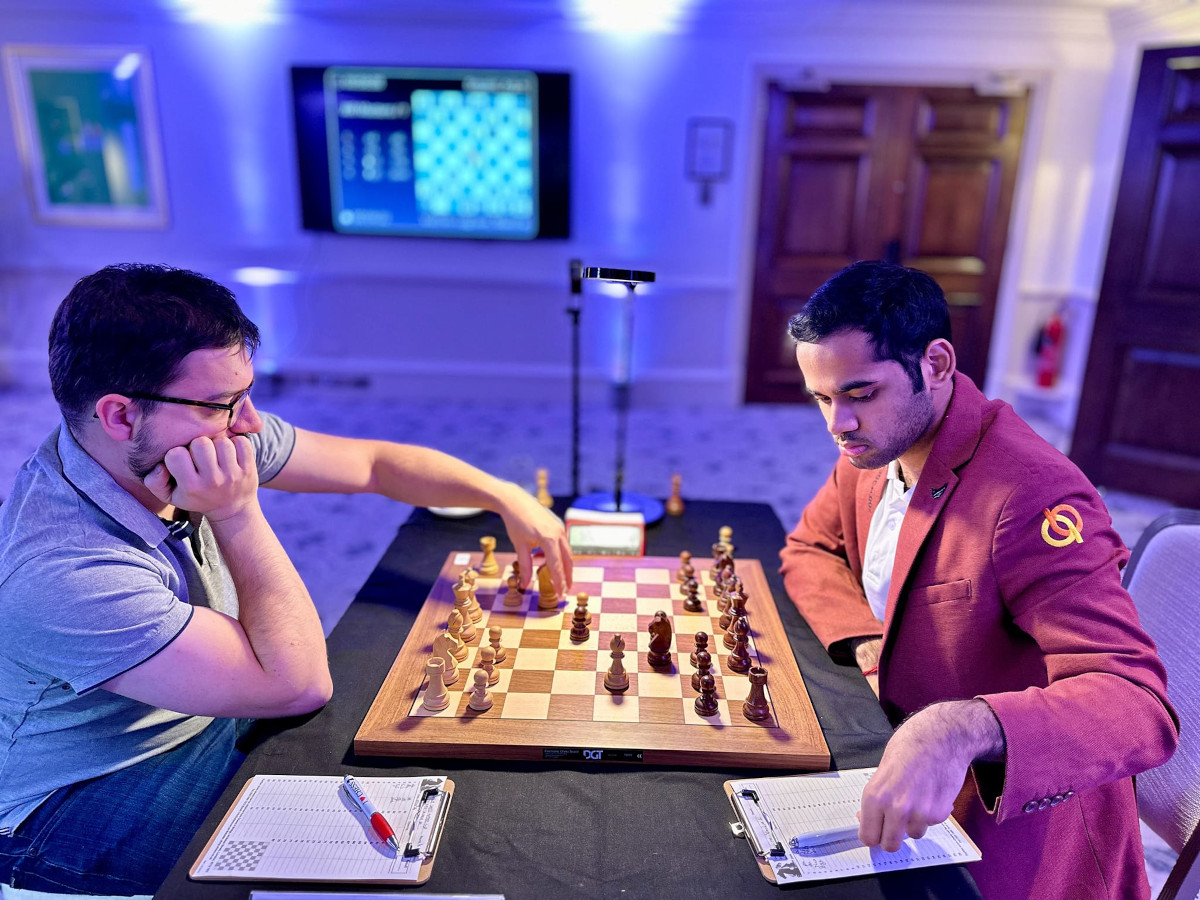
18/10/2024 – Arjun Erigaisi ganó la WR Chess Masters Cup tras derrotar a Maxime Vachier-Lagrave en desempates. Arjun, que había ganado todos sus matches anteriores en ajedrez clásico, se enfrentó a MVL, que había llegado a la final exclusivamente gracias a sus victorias en Armagedón. Tras firmar dos empates en partidas clásicas, Arjun mantuvo la compostura y ganó con negras en el desempate, asegurándose el campeonato en una reñida contienda. | Foto: ChessBase India / Abhyudaya Ram
novedad: ChessBase 18 - Mega package
Para ganar, primero debes aprender
La nueva versión 18 de ChessBase ofrece posibilidades completamente nuevas para el entrenamiento y el análisis de partidas: análisis del estilo de juego, búsqueda de temas estratégicos, acceso a 6.000 millones de partidas de Lichess, preparación del oponente tras una exploración de sus partidas en Lichess, descarga de partidas de Chess.com con API incorporada, motor de análisis en la nube y mucho más.
YOUR PERSONAL CHESS COACH - Whether you’re taking your first steps into the world of club chess, or already playing at a tournament level: with FRITZ, you can train more efficiently, intelligently and with a more personalised approach than ever before. FRITZ is more than just a chess engine – it’s a training revolution! Whether you’re taking your first steps into the world of club chess, or already playing at a tournament level: with FRITZ, you can train more efficiently, intelligently and with a more personalised approach than ever before.
GM Blohberger presents a complete two-part repertoire for Black: practical, clear, and flexible – instead of endless theory, you’ll get straightforward concepts and strategies that are easy to learn and apply.
89,90 €
Arjun mantiene la calma en el Armagedón
Arjun Erigaisi se hizo con el primer premio de 20.000 euros de la WR Chess Masters Cup en Londres al derrotar a Maxime Vachier-Lagrave en una partida 'Armagedón'. Arjun había eliminado previamente a Bodhana Sivanandan, Vidit Gujrathi y Praggnanandhaa Rameshbabu para llegar a la final. En una final dramática, superó a MVL para hacerse con el título.
Los dos finalistas llegaron al match decisivo por caminos opuestos. Mientras que Arjun ganó cada uno de sus encuentros previos en la porción clásica, MVL avanzó ganando los desempates de Armagedón en todas las rondas. Tras dos partidas clásicas igualadas en la final, la ventaja psicológica parecía favorecer a MVL (por haber jugado tres desempates antes), pero la sangre fría de Arjun le permitió imponerse con las piezas negras.
La primera partida clásica terminó en unas tranquilas tablas tras 30 jugadas. En la segunda, MVL jugó una aguda Siciliana Najdorf, creando a una posición caótica. Ninguno de los jugadores había enrocado hasta la jugada 14, y ambos se enfrentaban a duros desafíos tácticos. Es aquí que, en uno de los momentos clave de la partida, Arjun podría haber jugado 15.Axb7, lo que hubiera derivado en una compleja secuencia favorable para las blancas, pero en su lugar optó por 15.Ce4.
Aquí la partida podría haber seguido 15.Axb7 Ac4+ 16.Rg1 Axb3 (diagrama inferior), y ahora 17.Axa8 es mala por 17...Dc5+ 18.Rf1 Df2#. En esta línea, las blancas pueden jugar 17.Ce4, con una posición levemente mejor, pero la variante demuestra cuán complicados eran los cálculos que debían realizar ambos contendientes en esta lucha de doble filo.
In this course, we will learn how to identify passively placed pieces in any given situation and how to improve their health by bringing them into active squares.
Ambos finalistas sortearon bien las complicaciones y, tras el intercambio de damas en la jugada 21, la partida se encaminó hacia un final equilibrado, aunque complicado. Se acordaron tablas en la jugada 38 en una posición con alfiles de distintos colores y estructuras de peones asimétricas.
Maxime Vachier-Lagrave vs. Arjun Erigaisi | Foto: ChessBase India / Abhyudaya Ram
En el Armagedón, Arjun jugó con las piezas negras y con 6 minutos y 58 segundos en el reloj (ante los 10 minutos de MVL*). De forma temeraria, Vachier-Lagrave creó una posición desequilibrada desde el principio de la partida.
El 21.Cxf7 de las blancas fue un sacrificio correcto, aunque tras 21...Txf7, la continuación más precisa habría sido 22.Tb5, en lugar de la directa 22.Te6 como se jugó en la partida.
A pesar de tener menos tiempo en el reloj, Arjun mantuvo la compostura en el tenso final. Con MVL buscando desesperadamente opciones de victoria, Arjun fue ganando poco a poco la iniciativa y forzó el abandono de su oponente en la jugada 69.
The Indian chess grandmaster Vidit Gujrathi with an ELO of over 2700 (June 2023) is one of the best 20 players in the world. For the first time, the sympathetic top player presents himself in a video course. Let a world-class player show you tactical moti
* Se usó un sistema de pujas en los desempates: el jugador que aceptaba jugar con menos tiempo, recibía las piezas negras y la opción de conseguir la victoria en el match con las tablas.
La acción fue seguida de cerca por Sagar Shah y Vidit Gujrathi, que ofrecieron emocionantes comentarios para ChessBase India.
In this video course, experts (Pelletier, Marin, Müller and Reeh) examine the games of Viktor Korchnoi. Let them show you which openings Korchnoi chose to play, where his strength in middlegames were, or how he outplayed his opponents in the endgame.
Carlos Alberto ColodroCarlos Colodro estudió Filología Hispánica en Santa Cruz, Bolivia. Trabaja como traductor y escritor independiente desde 2012. Mucho de su trabajo se realiza en textos relacionados con el ajedrez, uno de sus más grandes intereses, junto con la literatura y la música.
YOUR PERSONAL CHESS COACH - Whether you’re taking your first steps into the world of club chess, or already playing at a tournament level: with FRITZ, you can train more efficiently, intelligently and with a more personalised approach than ever before.
How grandmasters win without fireworks: GM Jan Markos shows you 11 very practical tips from "How to play in a lost position" to "Be patient like Carlsen" that will improve your tournament chess.
The Nimzo-Indian has stood the test of time for over a century: Still a top choice for elite players today, from Magnus Carlsen to Praggnanandhaa, it remains one of Black's most reliable ways to fight for real chances against 1.d4 2.c4 3.Nc3.
1.c4 e5 2.Nc3 Bb4!? is an opening idea well worth considering. Black immediately threatens to double the pawns on c3 in the style of the Trompowski or Sicilian Grand Prix attack.
Italian Game Powerbase 2026 is a database and contains 8571 top class games from Mega 2026 and the Correspondence Database 2026, of which 479 are annotated.
We use cookies and comparable technologies to provide certain functions, to improve the user experience and to offer interest-oriented content. Depending on their intended use, analysis cookies and marketing cookies may be used in addition to technically required cookies. Here you can make detailed settings or revoke your consent (if necessary partially) with effect for the future. Further information can be found in our data protection declaration.
Pop-up for detailed settings
We use cookies and comparable technologies to provide certain functions, to improve the user experience and to offer interest-oriented content. Depending on their intended use, cookies may be used in addition to technically required cookies, analysis cookies and marketing cookies. You can decide which cookies to use by selecting the appropriate options below. Please note that your selection may affect the functionality of the service. Further information can be found in our privacy policy.
Technically required cookies
Technically required cookies: so that you can navigate and use the basic functions and store preferences.
Analysis Cookies
To help us determine how visitors interact with our website to improve the user experience.
Marketing-Cookies
To help us offer and evaluate relevant content and interesting and appropriate advertisement.




.jpeg)